Modern development teams move fast; security must keep pace. As organizations increasingly rely on GitLab to power CI/CD pipelines, integrating application security directly into the workflow is no longer optional — it’s essential. The Veracode GitLab Workflow Integration embeds automated security testing directly into GitLab pipelines, enabling teams to shift security left without disrupting delivery.
Automated Security at Every Commit in the GitLab Workflow
The integration brings automated security testing directly into GitLab CI/CD workflows, including:
- Static Application Security Testing (SAST)
- Software Composition Analysis (SCA)
- Infrastructure as Code (IaC) scanning
Scans are automatically triggered by code changes such as push and merge request events. Vulnerabilities are identified early in the development lifecycle, and developers receive immediate feedback within their existing pipeline workflow.
There are no manual uploads, no separate tools, and no context switching. Security becomes part of the natural CI/CD process.
Consistent Support Across All GitLab Deployment Models
The integration fully supports:
- GitLab.com (Cloud)
- GitLab Dedicated
- GitLab Self-Managed (On-Premises)
All core capabilities remain consistent across environments, including automated triggering, policy enforcement, pipeline status reporting, YAML-based configuration, artifact generation, and centralized visibility.
This ensures organizations with regulatory, compliance, or data residency requirements can embed security into their pipelines without architectural compromise.
High-Level Flow:
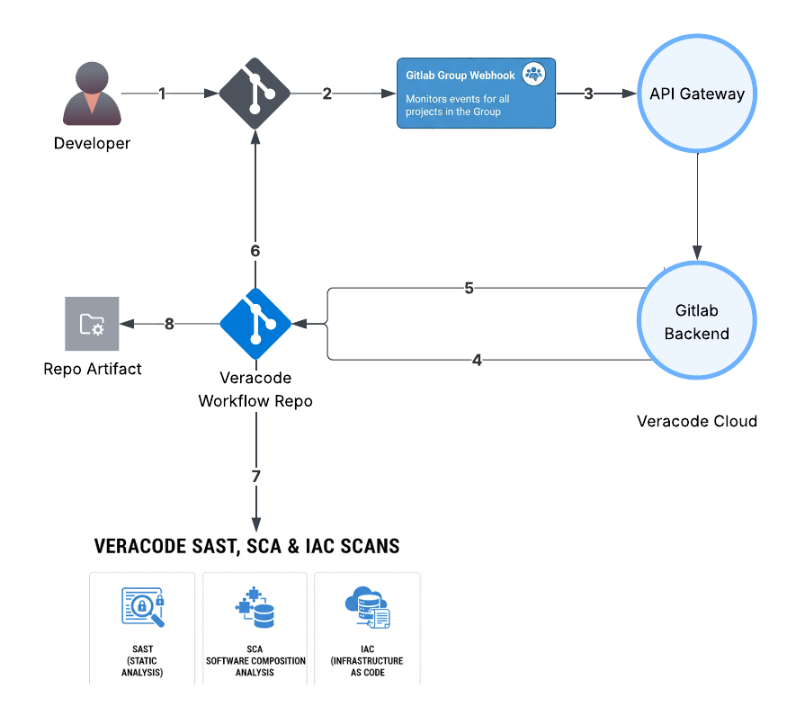
1] Developer Action: A developer pushes code or opens a Merge Request (MR) in GitLab.
2] Event Capture: A GitLab webhook detects this activity and sends the data to the Veracode Backend.
3] Authentication: The Backend validates the request’s digital signature to ensure it is legitimate and authorized.
4] Config Retrieval: The Backend fetches your specific settings (veracode.yml) and project lists via the GitLab API.
5] Workflow Trigger: Based on those settings GitLab App Backend triggers the appropriate GitLab workflows within the Veracode Workflow repository.
6] Code Access: The Veracode Workflow repository clones the developer’s source code to scan.
7] Security Scanning: The system runs Static Analysis (SAST), IAC and Software Composition Analysis (SCA) using secure Veracode tokens.
8] Reporting: Results are saved as artifacts and a summary report is automatically posted as a comment on the developer’s Merge Request.
Policy-Driven Configuration and Governance
Security must be enforceable — but adaptable.
Using a configurable veracode.yml file, teams can:
- Define which branches trigger scans
- Enable or disable scanning for merge requests
- Automatically fail centralise pipelines based on policy violations
Security leaders can define policy standards centrally, while development teams inherit automated enforcement directly within their pipelines. This model enables scalable governance without introducing friction into development workflows.
Granular Targeting Across Groups and Repositories
Organizations can precisely control what gets scanned by targeting specific GitLab groups or repositories.
This enables teams to:
- Gradually onboard projects into the security program
- Apply different policies to distinct business units
- Focus on high-priority or production repositories
- Optimize pipeline performance by avoiding unnecessary scans
Security programs can scale intelligently, balancing centralized control with repository-level flexibility.
End-to-End Security Scan Lifecycle
The integration supports the complete security lifecycle within CI/CD:
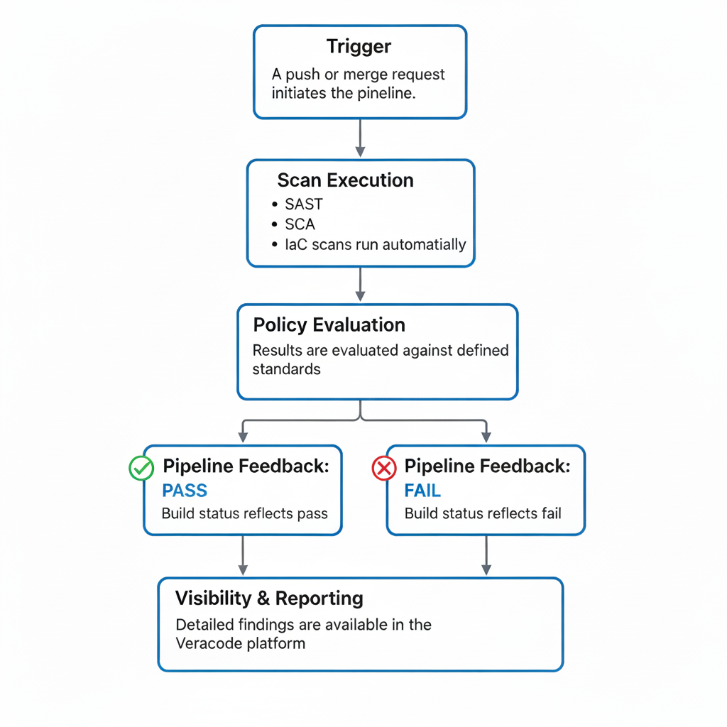
This continuous feedback loop enables teams to remediate issues before code reaches production, reducing downstream security risk and costly rework.
Enabling Secure, High-Velocity Development in GitLab
By integrating directly into GitLab pipelines:
- Developers receive actionable security feedback in their existing workflow
- Security teams gain oversight and standardized policy enforcement
- Time-to-remediation decreases
- Compliance and audit readiness improve
Security becomes embedded in delivery — not an afterthought.
Final Thoughts
DevSecOps is not about adding more tools. It’s about integrating security seamlessly into how software is built and delivered.
The Veracode GitLab Workflow Integration provides automated, policy-driven application security across cloud, dedicated, and self-managed GitLab environments — helping organizations innovate faster while minimizing risk.
Secure code should be the default. With this integration, it can be. Schedule a demo today to learn more.